


When we were planning our trip to Poland, I made Hubert promise that we would fit in two side trips: one to Wroc?aw and one to Gda?sk. I had been looking forward to both for months, carefully planning the details and imagining what it would be like to finally see these new cities.
Elbl?g: One of the Seven Wonders of Poland
On the way to Gda?sk, we decided to stop in Elbl?g to catch a glimpse of the famous boats that travel over land. Google Maps led us off into the forest, and for a while we weren’t sure we’d find the viewing points at all. We doubled back into the town, which is very small but picturesque, and treated ourselves to lody (ice cream). At the ticket office we learned that the best viewing points for the canal are actually a few towns over, so we left Elbl?g behind and continued on to our sidequest.
We finally found the canal station, and spent about an hour watching boats move from one part of the canal, over a short patch of grass and back into the water. It was a really interesting to watch this unique system, and I’d definitely recommend stopping by to check it out if you have time.
Gda?sk
Although Gda?sk was only about 40 minutes away from there, getting into the city was not easy. Traffic was heavy and Google misled us again, sending us to the wrong address. When we finally got to the correct building, the numbering system was confusing and not consecutive, which made things even more frustrating. After circling around several times, we asked the staff at an Indian restaurant in the same complex for help, and eventually found the office to pick up our keys. Then came the challenge of finding the actual entrance to the apartment. My husband finally called the landlord, who gave us clear instructions. By then we were tired, cranky, and hungry.
The apartment itself was modern and very clean, about 10–15 minutes from the riverfront. I had my heart set on dinner by the canal, but my husband suggested we eat at the Indian restaurant, Curry Marsala. This was partly because the staff had helped us earlier but also because it was so close to our apartment. I prefer local food when I travel, but I have to admit it was the best Indian meal I’ve ever had. Absolutely delicious. With full stomachs, we felt much better and took a walk down to the riverfront. The views were incredible and instantly lifted our spirits.
The next morning we visited the European Solidarity Centre, dedicated to the Solidarity movement led by Lech Wa??sa. It’s an inspiring space, and walking through the exhibits gave us a real sense of the courage and determination that shaped modern Polish history. Later, a sudden rain shower sent us running to a small hut for shelter. Hubert bought kielbasa with bread from a vendor nearby, which turned out to be a perfect snack while we waited for the weather to clear, and brought him good memories from his childhood.
From there, we headed to Gda?sk’s Old Town. Unlike many European cities where the “old town” is centered around a single square, the Gda?sk historic district feels more like a neighborhood, with street after street of beautifully restored architecture. We happened to be there during St. Dominic’s Fair, one of the oldest and largest markets in Europe. It filled the streets with energy and music, and stalls selling everything from crafts to sweets.
We stopped for lunch just outside of the gates of the Old Town, where the modern city meets the historic quarter. There were a few food vendors in this area, serving traditional Polish dishes. We chose a stall selling grilled meat and roasted potatoes. We washed it all down with a tasty local beer.
After lunch, we took a boat tour down the Mot?awa River to Westerplatte, the peninsula where the first shots of World War II were fired. The ride was just over an hour long and gave us a great perspective of the city from the water. The boat passed by shipyards, ports and drydocks with shipping containers stacked high along the river.
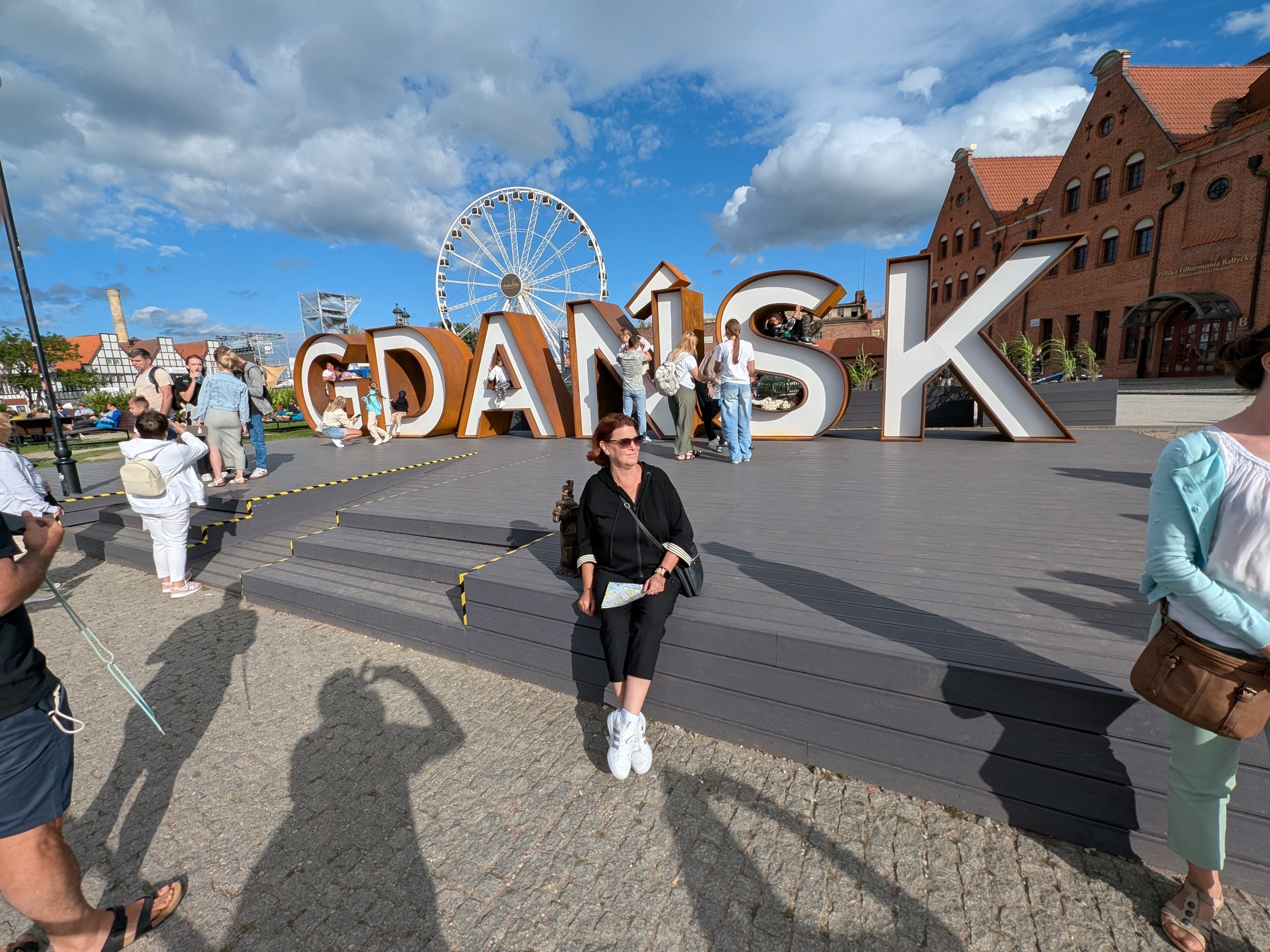
We returned just in time to cross the drawbridge to Granary Island (Wyspa Spichrzów) which is only lowered every hour. (It stays up to let larger boats pass through during the day). Once on the island, we took a ride on the Ferris wheel, which offered sweeping views over the city and the river. Of course we had to pose with the Gdansk sign (where you even there if you didn’t pose with the sign?!).
It was a long day so we headed back to the apartment for a rest before heading out for dinner. I had chosen a place called Swojski Smak, located away from the busy riverfront. The waterfront looked beautiful but also very crowded and touristy, and we suspected the prices would be much higher there as well.
Swojski Smak offered hearty Polish cuisine and a menu featuring 150 types of vodka. Our meal was excellent, and we tried a shot of the house cherry vodka, which was smooth and full of flavour. To our surprise, the waitress also brought us a couple of complimentary shots of apple pie–flavored vodka (perhaps because I had entertained her with my rudimentary Polish ?). It was sweet, warm, and went down so nicely. We had thought about taking one last evening walk by the river, but after a long day of exploring we both agreed we’d had enough and decided to call it a night.
A Quick Visit to the Seaside
The next day, we headed out after a quick breakfast because our sightseeing was not over. Since Sopot is just 30 minutes from Gda?sk, we couldn’t pass up the chance to visit this popular seaside town. Sopot’s sandy beaches, elegant resorts, and lively boardwalk have earned it the nickname “the Polish Riviera.” While it’s not as warm as Mediterranean destinations, it has a vibrant atmosphere all its own. A walk along its historic pier is a must, as is a stroll by the water’s edge. Because we still had another destination to fit in that day (well, two if you count a family visit), we didn’t spend nearly as much time there as I would have liked. But I know I’ll be back in Gda?sk someday, and a longer stop in Sopot will be high on the list.
Malbork Castle
Our next stop was the town of Malbork to explore Malbork Castle. I’d been looking forward to it—I love castles and the history behind them. But first, lunch! We found a riverside restaurant that mainly served Italian food, though the menu had one traditional Polish dish tucked in. The waiter was amused when we both ordered the kotlet schabowy, but it was the perfect choice: crispy, hearty, and just what we needed before tackling the castle tour.
Malbork Castle, built in the 13th and 14th centuries by the Teutonic Knights, is the largest castle in the world by land area. Unlike most castles, no royalty ever lived here. Instead, it served as a medieval fortress and housed knights and clergy. The castle was heavily damaged during WWII but was painstakingly restored, most recently in 2016. Its rooms may seem austere compared to royal palaces, but they still reveal fascinating glimpses of life in the Middle Ages. If you love history or ancient architecture, Malbork is absolutely worth a visit.
It had been a long day, but we still had one final stop. On the way home, we called in to Niedzice to visit Hubert’s aunts and uncle. As is customary in Poland, the table was overflowing with food—his aunt had prepared a spread of Polish delicacies, far more than we could possibly finish. It was lovely to catch up with family over such a generous meal. Thankfully the ride home was smooth, and when we finally rested our heads that night, we were exhausted but content, already dreaming about our next adventure.

Leave a Reply